Framing & Wiring
All artwork accepted into MAA shows must be exhibition-ready at the time of drop-off. Work that does not meet these standards may not be accepted into the show, and it is the artist's responsibility to arrive fully prepared.
Framing & Wiring Standards
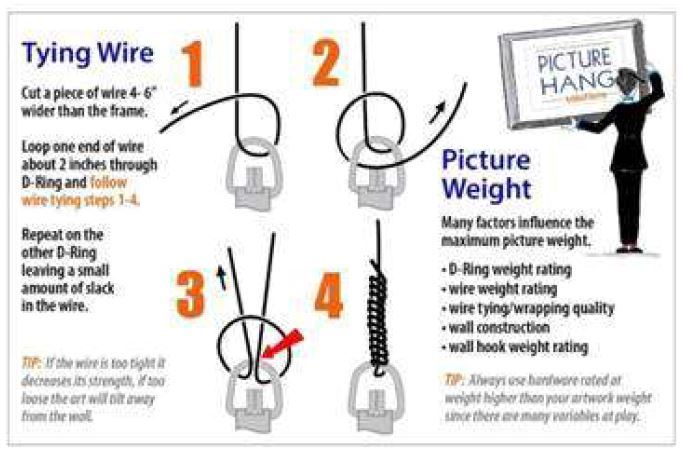
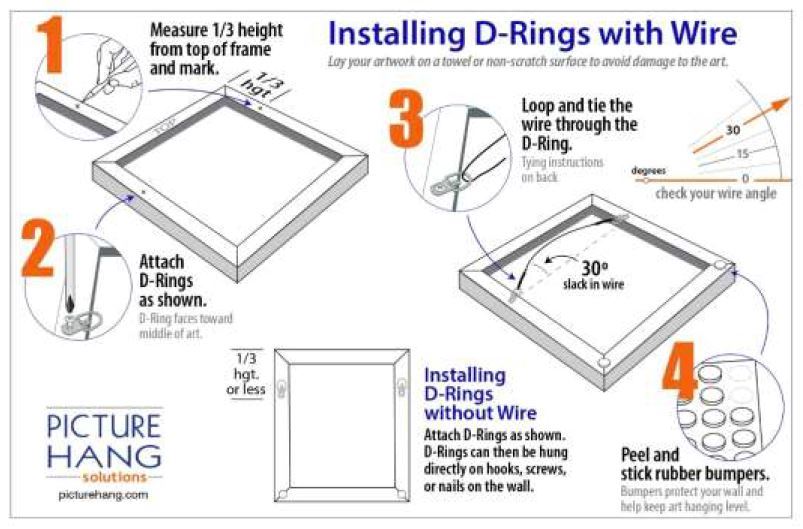
- Framed works must be wired for hanging to professional standards. Use D-rings and weight-appropriate wire that is not visible when the piece is hung.
- Do not use saw-tooth hangers, spring clips, or other frame hardware not designed for hanging. Spring clips are meant to secure backing and glazing inside a frame — they are not a substitute for D-rings and wire and are not strong enough to safely support the artwork when hung.
- Do not submit wet canvases.
- Glazing requirements apply only to works on paper (drawings, watercolors, prints, photography on paper, etc.) — not to paintings or photography on canvas. Works on paper larger than 20"x28" must be glazed with Plexiglass (or equivalent). Pastels must be glazed regardless of size.
⚠️ We strongly advise using real glass rather than Plexiglass for pastels; the static charge from plexiglass can literally pull the pastel dust off the page and onto the inside of the plastic sheet, ruining the artwork.
Examples of Proper wiriing and D-ring placement -- below.
 .
.
Unframed Canvas / Gallery Wrap
Paintings on canvas do not require a frame, provided the canvas is gallery wrapped — stretched over a deep stretcher bar (typically 1.5" or deeper) so the canvas completely covers the sides, with no visible staples or tacks — and the wrapped edges are finished using one of the following methods:
- The image is continued or wrapped seamlessly around the sides (gallery wrap), or
- The edges are painted a clean, solid, complementary color (often neutral grey, charcoal, or black).
Canvases on thinner, standard-depth stretcher bars (around 0.75") typically can't be gallery wrapped cleanly and should instead be enclosed in a traditional or floater frame to fully conceal the edges.

A wrong or sloppy gallery wrap leaves bare, unpainted canvas or white factory primer visible along the side edges, staples or tacks exposed on the sides rather than secured to the back, or stray paint drips running down unfinished edges. This makes an unframed piece look unfinished and exposes accidental smudges, fingerprints, or blank primer lines to the viewer.

Not accepted: wrong/sloppy gallery wrap
Raw or unpainted canvas edges are not accepted, even if the canvas is properly stretched. Unstretched canvas must be framed — the no-frame exception only applies to canvas that has been stretched and gallery wrapped as described above. Photos of each acceptable edge treatment can be seen in our Gallery Wrapping Guidance.
⚠️ Unstretched canvas must be framed. The no-frame exception only applies to canvas that has been stretched over bars (gallery wrapped) with finished edges — not to unstretched or rolled canvas.
Not accepted: raw edge canvas - exposed staples

If Framing or Wiring Doesn't Meet Standards
It is the artist's responsibility to properly frame and wire their artwork to meet show standards before drop-off. If framing or wiring is faulty at the time of hanging, the artwork will not be hung in the show. However, as a courtesy, MAA usually has tools on hand at drop-off that artists may use to fix minor framing or wiring issues. If the issue cannot be resolved to meet standards at that time, the artwork will not be hung — plan to pick it up from the show manager.
⚠️ Framing/wiring checked at drop-off. It's the artist's responsibility to meet standards before arriving. MAA may have tools on hand as a courtesy to help fix minor issues, but unresolved problems mean the work will not be hung.
 © 2025 Montgomery Art Association Inc., PO Box 2154, Kensington, MD 20891
MAAartists@gmail.com